



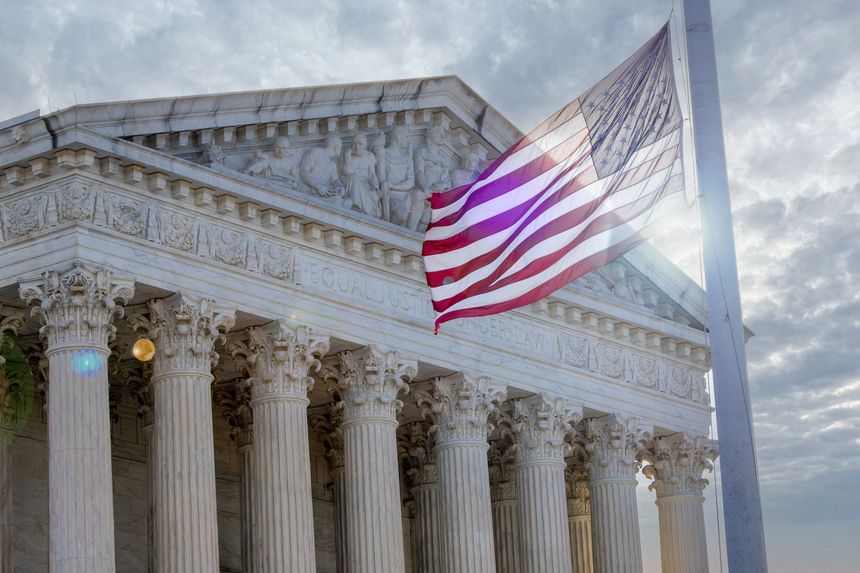

A case nominally about a fired government commissioner may reshape the corporate environment for every federally regulated business in America. The Supreme Court’s decision in Trump v. Slaughter, expected by the end of June 2026, will determine whether the president can fire the leaders of the nation’s independent regulatory agencies at will — and the answer is likely yes.
How We Got Here
In March 2025, President Donald Trump fired Rebecca Kelly Slaughter, a commissioner on the Federal Trade Commission (FTC), telling her in an email that her continued service was “inconsistent with my administration’s priorities.” The issue: federal law says FTC commissioners can only be removed for “inefficiency, neglect of duty, or malfeasance in office.” Slaughter sued, won in the district court, and the D.C. Circuit refused to put her reinstatement on hold.
The administration took the case directly to the Supreme Court. The Court granted an emergency stay in a 6-3 split — thus preventing Slaughter’s reinstatement while the case was litigated. As Justice Elena Kagan noted in the dissent filed with the Court, granting that stay — before full briefing, before argument, before any ruling — was itself a signal. The Court’s emergency docket does not grant stays unless a majority believes the underlying legal position holds a “fair prospect” that the lower court got it wrong — a standard that, combined with the 6-3 split and the grant of certiorari before judgment, led many court observers to read the stay as a strong signal of the majority’s likely conclusion.
The case asks two questions the Court directed the parties to brief: whether the FTC’s statutory removal protections violate the separation of powers, and whether Humphrey's Executor v. United States — the 1935 precedent that made modern independent agencies constitutionally possible — should be overruled.
The government argued that the president must retain full removal authority over officers who exercise executive power, and that Humphrey’s Executor has become a “decaying husk” that tempts Congress to erect a “headless fourth branch insulated from political accountability and democratic control.” Commissioner Slaughter countered that multi-member commissions with removal protections “have been part of our story since 1790” — and that if the government were right, “all three branches of government have been wrong from the start.”
Justices Samuel Alito, Amy Coney Barrett, Robert Gorsuch, Brett Kavanaugh, John Roberts and Clarence Thomas clearly seemed to agree with the Trump administration that the FTC Act’s removal protections violate the separation of powers. Justice Gorsuch questioned whether Slaughter’s own argument amounted to "a recognition that Humphrey’s Executor was poorly reasoned" — since her lawyers had abandoned the original 1935 theory and tried to construct a new one.
Why Your Business Should Care
A decision in the government’s favor would change the way many independent agencies carry out their statutory duties. Companies that deal with the Equal Employment Opportunity Commission (EEOC) or National Relations Board (NLRB) will want to watch the outcome here — a ruling for the president would allow him (and future presidents) to immediately replace commissioners who don’t share his policy priorities, shifting each agency’s enforcement focus with each new administration. The same is true for companies regulated by the Securities and Exchange Commission (SEC), the Nuclear Regulatory Commission, or Federal Energy Regulatory Commission (FERC).
A decision by the Court to expand presidential removal authority may result in frequent leadership changes at the agency level affecting industry regulation, public services and compliance procedures. In plain terms: the enforcement priorities of agencies that regulate your business — how aggressively they pursue investigations, what violations they prioritize and what settlements they accept — would shift with each new administration, and potentially far more rapidly than they do today.
If the Court rules broadly in favor of the government, the “independent” agency may become a thing of the past, where agency heads at the FTC, EEOC, and NLRB serve at the pleasure of the president rather than fixed terms — and businesses should prepare for a regulatory environment that is less predictable and more susceptible to swift political pivots.
There is one notable exception (possibly). During oral argument, Justice Kavanaugh pressed the government for its views on the president’s authority to fire Federal Reserve governors — but the Court appears ready to distinguish the Federal Reserve as a “unique” and “distinct” institution that would not be subject to the ruling based on its history, structure and function. The Supreme Court previously noted “[t]he Federal Reserve is a uniquely structured, quasi-private entity that follows in the distinct historical tradition of the First and Second Banks of the United States.” Trump v. Wilcox, 145 S. Ct. 1415, 221 L. Ed. 2d 985 (2025). Although Wilcox was a stay order and not a merited opinion, Justice Kavanaugh’s oral-arguments comments in Slaughter align with Wilcox.
Three Takeaways for In-House Counsel and Business Decision-Makers
- Audit your agency relationships now. If your business is currently under investigation or in active proceedings before the FTC, EEOC, NLRB or SEC, document the current posture of those proceedings carefully. A change in agency leadership following a ruling in the government’s favor could shift enforcement priorities mid-proceeding — in either direction.
- Build flexibility into your compliance programs. Compliance programs calibrated to the enforcement priorities of a specific agency leadership team will need to be more adaptive. Design programs around the statutory requirements themselves — not just current agency guidance — because that guidance can change overnight when leadership does.
- Watch the Federal Reserve question separately. If your business has commercial banking relationships, financing structures, or interest-rate-sensitive contracts, monitor Trump v. Cook — the companion case about whether the president can fire Federal Reserve governors — as a separate risk. The Court is likely to treat it differently, but the outcome remains unsettled.
A ruling is expected by the end of June 2026. This is one to watch.
/Passle/673b7187983090b59d166389/SearchServiceImages/2026-09-15-13-34-37-479-6aa9496dc429248dfcfa54b6.jpg)
/Passle/673b7187983090b59d166389/SearchServiceImages/2026-09-04-17-45-45-749-6a9b03c99a3310b0baa541b7.jpg)
/Passle/673b7187983090b59d166389/SearchServiceImages/2026-07-28-17-07-33-102-6a68e1d52f7f4abc6245626e.jpg)
/Passle/673b7187983090b59d166389/SearchServiceImages/2026-07-24-16-53-59-177-6a6398a7a0012819d1715c18.jpg)